
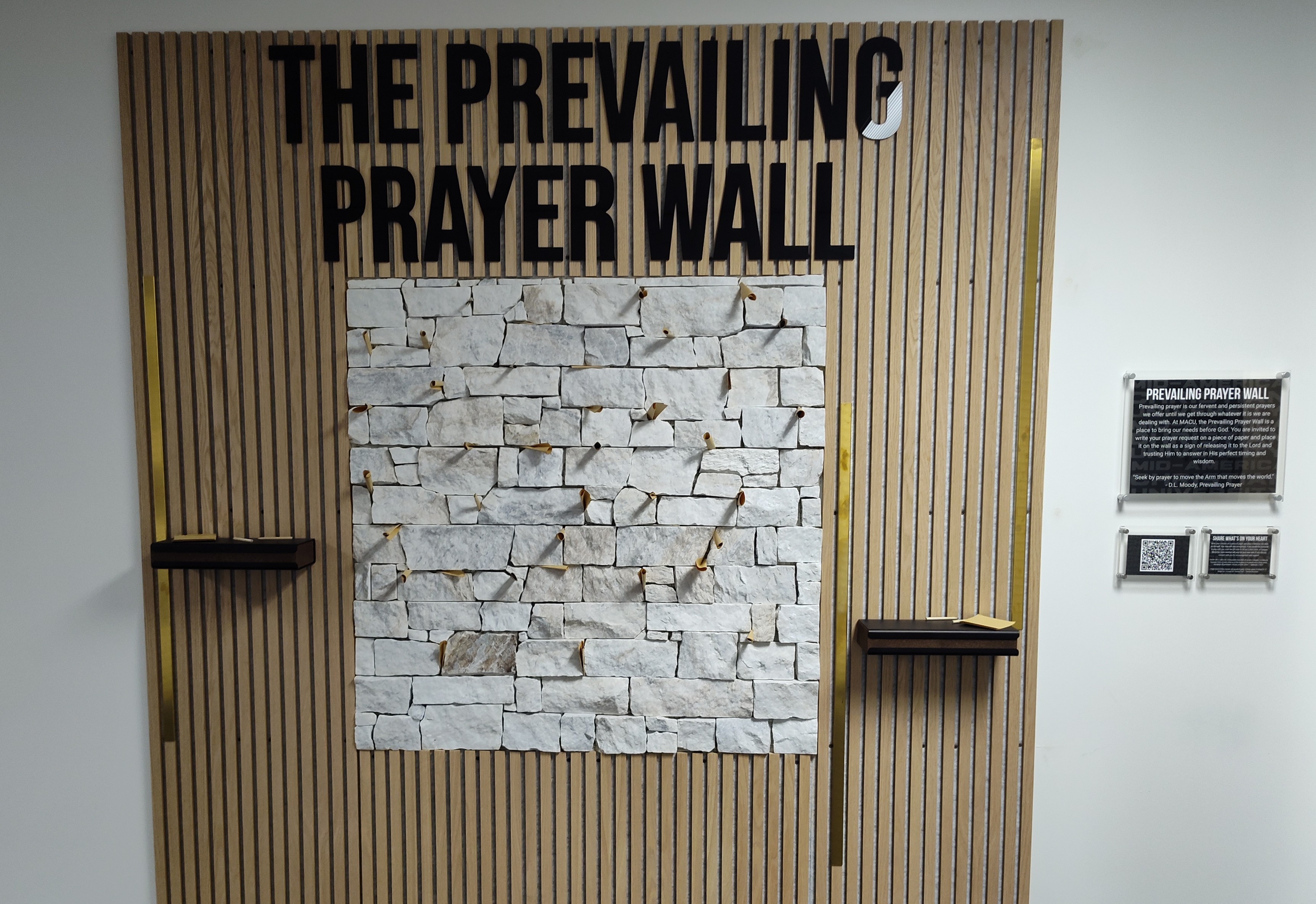
As I posted last month, we have a “Prevailing Prayer Wall” at Mid-America Christian University. Then, I came across something that tied in with that post so readily that I wanted to share it with you. As you likely know, I occasionally use my blog space to expose you to something that is so good that I would only dilute it if I tried to alter it sufficiently, as to make it my own. (This is in addition to the ethical problem that would exist if I tried to take credit for someone else’s work.)
What follows is a piece by Dr. A.J. Swoboda, he writes:
A friend once told me a story about a man who was married to a beautiful, lovely woman. They had three children. And they seemed to be enjoying their life together. It was discovered that the man had been secretly having an affair with someone he had gone to high school with. It came to light that they had reconnected on social media after all these years. Soon, what started as simple chit-chat became more. The old friend became an emotional confidante. And the husband started going to her rather than his wife for conversation. What began as quiet, hidden support eventually turned into a full-blown affair. Because he felt unheard by his wife, he went where he did feel heard.
Horrible as it is, stories like this happen. Often. In both marriages—and in our life with God. Throughout the Old Testament, God describes his relationship with the people of God as that of a husband and wife (Isa. 54:5; Jer. 31:32; Hos. 2:19–20). And, likewise, the same Scriptures speak of a breakdown of that relationship in the same terms as marital infidelity (Jer. 3:8–9; Eze. 16:32; Hos. 1:2). And, like in any human marriage, it is not often that we begin an affair in a moment. Instead, it starts with emotional footsie, rekindled loves, and small movements toward unwise intimacy.
One of the often unspoken problems Christians face with prayer is that it can leave us feeling unheard. This is, for example, the experience of the author of Psalm 88. This particular Psalm is a song of utter despair. As do many of us, the author is baring their soul to God and asking (in the midst of life’s frustrations) where God is and why he is doing it. There is a section in the Psalm where the author asks six rhetorical questions and receives a silent six “no’s” in response to those questions:
Do you show your wonders to the dead?
A silent ‘no’ is assumed.
Do their spirits rise up and praise you?
Again, the silent ‘no’ is assumed.
Is your love declared in the grave?
Seriously, a silent ‘no,’ God?
Is your faithfulness in Destruction?
You can’t be serious, God, can you?
Are your wonders known in the place of darkness?
This is just getting silly—another ‘no.’
Are your righteous deeds in the land of oblivion?
Well, I don’t know why I keep putting up with this.
And yet, not getting the answers they desire and likely need, the author continues to petition God. And they do not stop. This Psalm is but one of two lament Psalms in the Bible in which there is neither a resolution nor an anticipatory praise at the end of the song. That is, there is no divine bow at the end of the psalm. The song ends with meyuddaʿai maḥshakh (Heb. מְיֻדָּעַי מַחְשָׁךְ). It can be translated as “my acquaintance—the darkness.”
That this Psalm has even been included in the Psalter and the Bible’s canon is highly significant. Why? For the same reason I hate Hallmark Christmas movies. Not because they lack cheery messages that warm the heart. My problem is that they always end well. There is a scripted perfection to the ending of every story. These movies bother me because they give the false impression that life is a story of sequenced perfections and that everything ends well. That the Bible refuses to offer a version of life that is anything less than as gritty and real as life actually is speaks to both its authenticity and its prophetic vision. Psalm 88 is in the Bible because Psalm 88 is sometimes like most of our lives. Many of the stories of our lives end with darkness.
With no bow on top.
Part of the reason, I suspect, that we are tempted to abandon our faithful love for God is that we find ourselves feeling dissatisfied and unheard in our lives of prayer. We talk to God, we petition God, we seek him, we trust him—and experience “no’s.” Or darkness. Or silence. And, as anyone would, when we feel like we are being unheard, we gravitate so quickly to those whom we feel do hear us. So we slowly start turning to the creeping intimacy that other, lesser gods (money, power, influence, sin, habits) offer, which seems to make us feel heard.
But Psalm 88 has a powerful lesson for us. And that is that a built-in part of talking to God can often involve feeling unheard. Praise God for the moments of prayer when we hear the answer, the direction is clear, and the pathway is evident. Those moments happen. But they don’t always happen. And when they don’t, we are given Psalm 88 to structure our faith. A life with God is not a life in which we should always expect to feel heard as we would wish. We can trust that we will always be heard. “The righteous cry out,” David would write, “and the LORD hears them.” (Ps. 34:17) God always hears. But we also need to experience moments when it does not feel like we are being heard.
Something happens in us when we don’t feel heard—even if we are being heard. It cultivates in us what Jesus calls “persistence.” We have an entire parable about a widow in Scripture who, through knocking and knocking and knocking, annoyed the one she was petitioning into responding (Lk. 18:1-8). The experience of having a prayer feel unheard can actually be one of God’s most sacred means of cultivating in us the persistence needed to survive a world like our own.
There’s a story about a Jewish man who stood at the Wailing Wall in Jerusalem day after day. His prayer? He was asking God for the peace of Jerusalem. Which never came. Despite his prayers, the city became increasingly full of bloodshed and violence. A pious friend saw him praying despite what was happening in the city. And he asked him about his prayers for peace. The praying man said, “I feel like I have been talking to a wall!”¹
That is sometimes the sign we are doing it right. For our sake—if Psalm 88 has anything to do with it—talking to a wall seems to be a transformative experience that we should learn to feel more and more comfortable with. The feeling of being unheard is as important as any experience in our life with God.
Just as it can also be the place we can tend to run to other lovers.





Leave a Reply